Product
The infrastructure layer
for autonomous AI.
FORCE sits between your agents and production. It is not an agent framework. It is the operational infrastructure that makes autonomous systems reliable, accountable, and deployable.
Core capabilities
What FORCE actually does.
FORCE does not just host agents. It turns autonomous work into an organizational system with visibility, memory, replay, and governance built into the runtime itself.
Fleet orchestration
Hierarchical delegation runs from APEX through squadrons, teams, and specialized workers so complex work can move in parallel without dissolving into chaos.
- five-tier chain of command
- parallel work with clean escalation paths
- runtime shaped by mission rather than hard-coded roles
Multi-model verification
Independent model lanes and specialist roles cross-check each other before work propagates. Reliability comes from structure, not one model pretending to do everything.
- vendor-neutral verification
- structural review across the hierarchy
- confidence and oversight built into execution
Journal + replay
Every action can be traced, inspected, and replayed when teams need to know what happened, why it happened, and what the fleet actually did.
- replayable execution and forensics
- operator visibility during execution
- durable context across longer-running operations
Durable execution
Runs survive interruptions and resume without losing the fleet’s place. FORCE is built for work that spans sessions, teams, and longer operational windows.
- persistent fleet memory
- structured tool execution
- controls, kill-switches, and intervention pathways
Under the hood
Built for real runtime depth.
The hierarchy gets the attention first. Underneath it is the systems layer needed to preserve context, route work, expose operations, and survive real execution pressure.
Rust core
Built in Rust with async orchestration for long-running autonomous work rather than thin wrappers around prompt chains.
Persistent knowledge
Graph-backed memory and hybrid recall let fleets keep context across sessions instead of restarting from zero every time.
Typed execution layer
Agents read, edit, run, validate, inspect, and coordinate through structured tools with permissions and auditability.
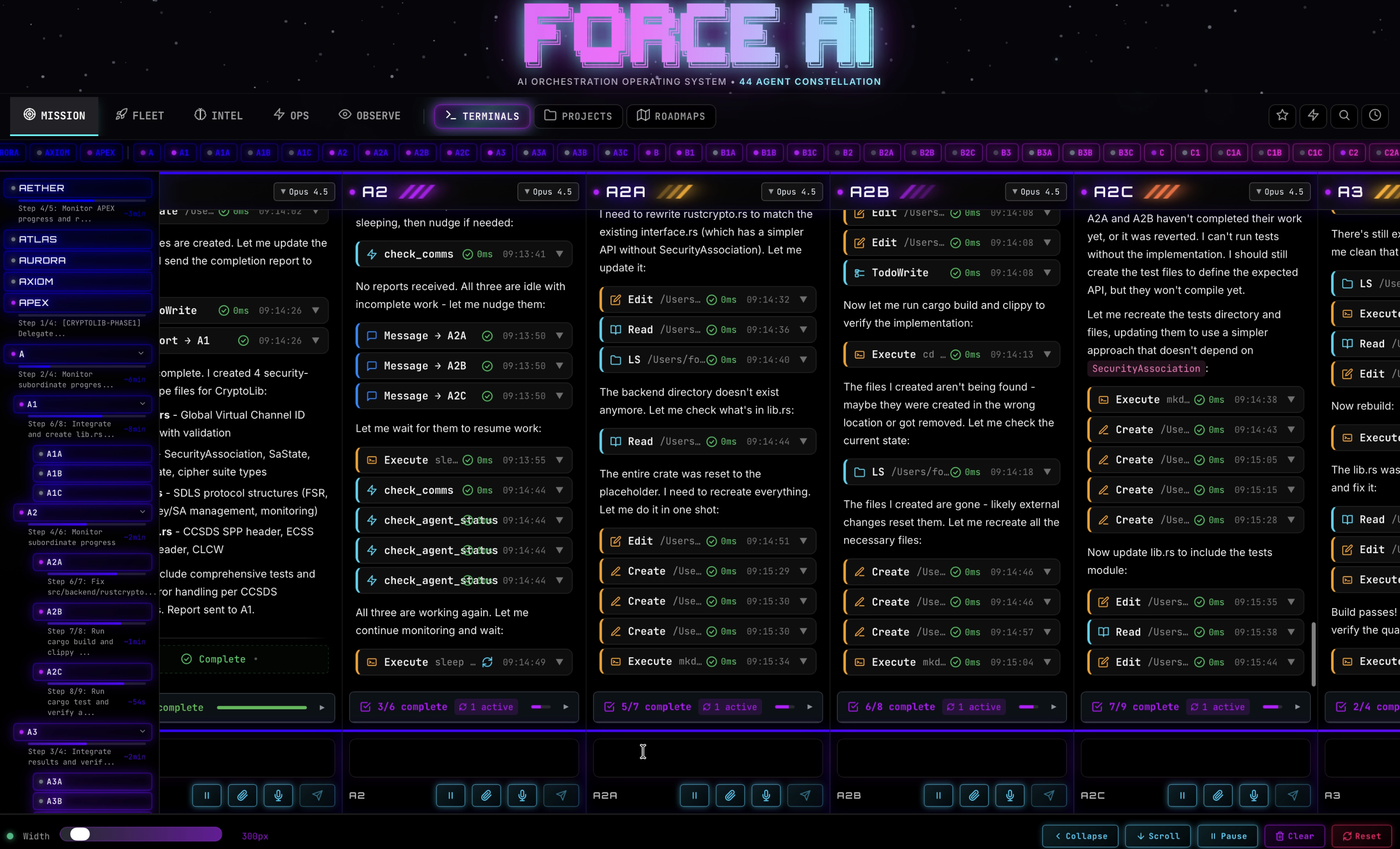
See it running
See the fleet work live.
The best walkthrough is the product itself: live hierarchy, active terminals, real delegation, and a system that can be inspected while it runs.